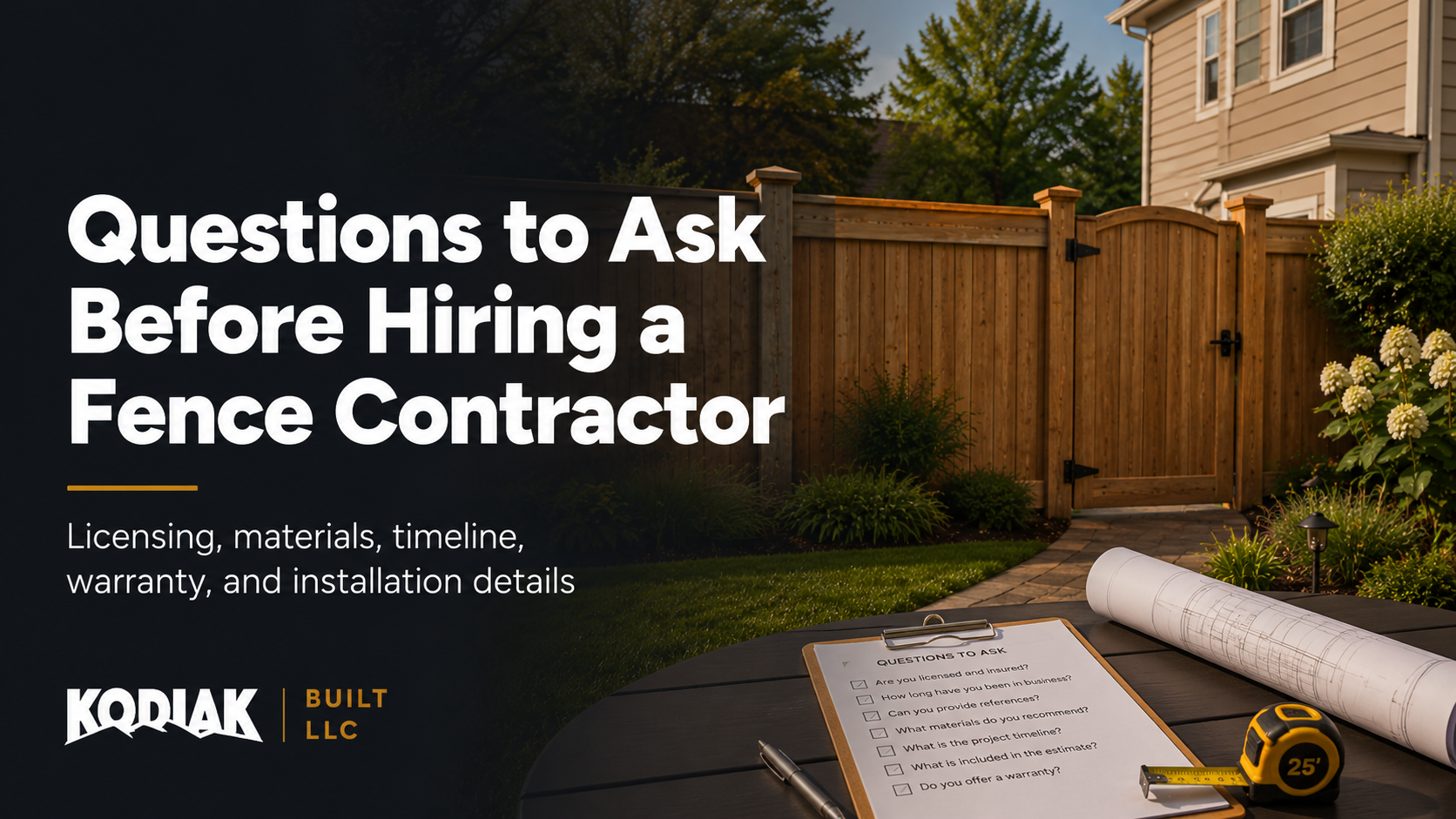
“Licensed and insured” is painted on half the work trucks in Wisconsin. It sounds like a credential — official, inspected, vouched-for. So here's the fact worth knowing before you hire anyone: Wisconsin has no statewide license for fence contractors. There is no state fence-installer exam, no state fence-installer card.
That doesn't make the phrase meaningless. It means the meaningful half is “insured” — and it means you should know exactly what to verify, because the state isn't verifying it for you.
What “licensed” usually means on a fence truck
For fence work specifically, “licensed” typically refers to business registration — being a real, registered Wisconsin company — or to municipal contractor registration where a town requires it. Those things matter, but notice what they aren't: nobody tested that contractor's post depth, and no state board reviews their gate hardware.
So treat “licensed” as table stakes, not vetting. The vetting is the insurance, the references, and the post spec.
The two policies that actually protect you
General liability
This is the policy that answers for damage to your property. The classic examples are all real: the utility line that gets clipped, the concrete truck across the driveway apron, the panel that goes over in a gust before it's braced and finds the neighbor's siding. With liability coverage, an insurer handles it. Without it, you're chasing a small business for repairs it may not be able to fund.
Workers' compensation
Fence work is physical — augers, concrete, panels moving in wind. Workers' comp covers a crew member hurt on your property. Here's the part homeowners miss: if a contractor has no workers' comp and someone is injured on your lawn, questions can land uncomfortably close to your homeowner's policy. Their coverage is your firewall.
How to verify, in five minutes
- ✓Ask for certificates of insurance — general liability and workers' comp.
- ✓Check the named insured matches the company on your quote.
- ✓Check the coverage dates cover your project window.
- ✓Note the response: a same-day COI is the mark of a real operation.
The ask isn't rude — it's routine. Contractors carry insurance precisely so customers can rely on it, and the good ones are proud to send the certificate. We include ours whenever a homeowner, lender, or HOA asks.
Where permits fit into this
Permits and licenses get blurred together, but they're different animals: a fence permit approves your specific project under municipal rules; it says nothing about who's building it. A contractor who pulls the permit for you is showing you their process — a contractor who tells you to skip it is showing you something else.
Red flags, quickly
- ✓“We're licensed” with no certificate to show for the insurance half.
- ✓COIs that are expired, or name a different company than your quote.
- ✓Cash-only pricing, big up-front deposits, no physical footprint.
- ✓“You don't need the permit.”
Bottom line
In a state with no fence-contractor license, “licensed and insured” is only as good as the paper behind it. Verify the two policies, confirm who pulls the permit, and weigh the rest of the checklist from there. It's five minutes of homework that de-risks a five-figure yard.
Want to see how we answer all of this? Ask away — then get the written quote and compare.
Quick answers
What insurance should a fence installer carry in Wisconsin?
Two policies: general liability, which covers damage to your property, and workers' compensation, which covers crew injuries so they don't become your problem. Ask for current certificates of both.
What does general liability insurance cover on a fence job?
Damage the contractor causes to your property while working — the struck gas line scenario, the cracked driveway, the neighbor's siding. Without it, you're negotiating repairs with whoever answers the phone.
How do I verify a contractor's insurance?
Ask for certificates of insurance (COIs) naming the company, and check the coverage dates are current. Any legitimate contractor's insurer or office can send them same-day — hesitation is itself an answer.